Bringing clinical intelligence to Hong Kong's residential care homes — earlier warnings, smarter decisions, better outcomes.

Cyberhealth Limited
Cyberhealth Limited is a Hong Kong AI telehealth innovator dedicated to improving outcomes in residential care homes for the elderly (RCHE). We believe that better care starts with better information — delivered at the right moment, to the right person.
Our systems are designed entirely within existing Hong Kong regulatory frameworks, including the Personal Data (Privacy) Ordinance (Cap. 486) and the Pharmacy & Poisons Ordinance (Cap. 138). Data stays on-premises. No new hardware required.
AI Telehealth is the delivery of clinical intelligence remotely — using artificial intelligence to monitor, predict, and coordinate care without requiring a doctor or pharmacist to be physically present at every decision point.
For Hong Kong's 75,000+ elderly residents in RCHEs, this means earlier intervention, fewer unnecessary hospital admissions, and better quality of life — delivered through the care teams already on the ground.
Continuous analysis of vital signs and clinical indicators across every resident, surfacing risk before it becomes crisis.
Machine learning models trained on tens of thousands of real RCHE records predict hospitalisation risk with 0.93 negative predictive value.
Pharmacists and physicians receive prioritised alerts and can review, escalate, and document care decisions without being on-site.
Works within existing RCHE workflows and HK regulations. No new hardware, no specialist IT, no disruption to daily routines.
All data processed on-premises under HK PDPO (Cap. 486). No resident data leaves the care home without explicit consent.
AI surfaces the signal; clinicians make every decision. Designed to augment — not replace — the skilled professionals caring for residents.
The AI Early Warning Score runs inside an ordinary spreadsheet — no new sensors, no cloud infrastructure, no specialist IT required.
BP, pulse, temperature, SpO₂, weight — already taken in every RCHE. Plus chronic conditions and current medications. No new data, no new device.
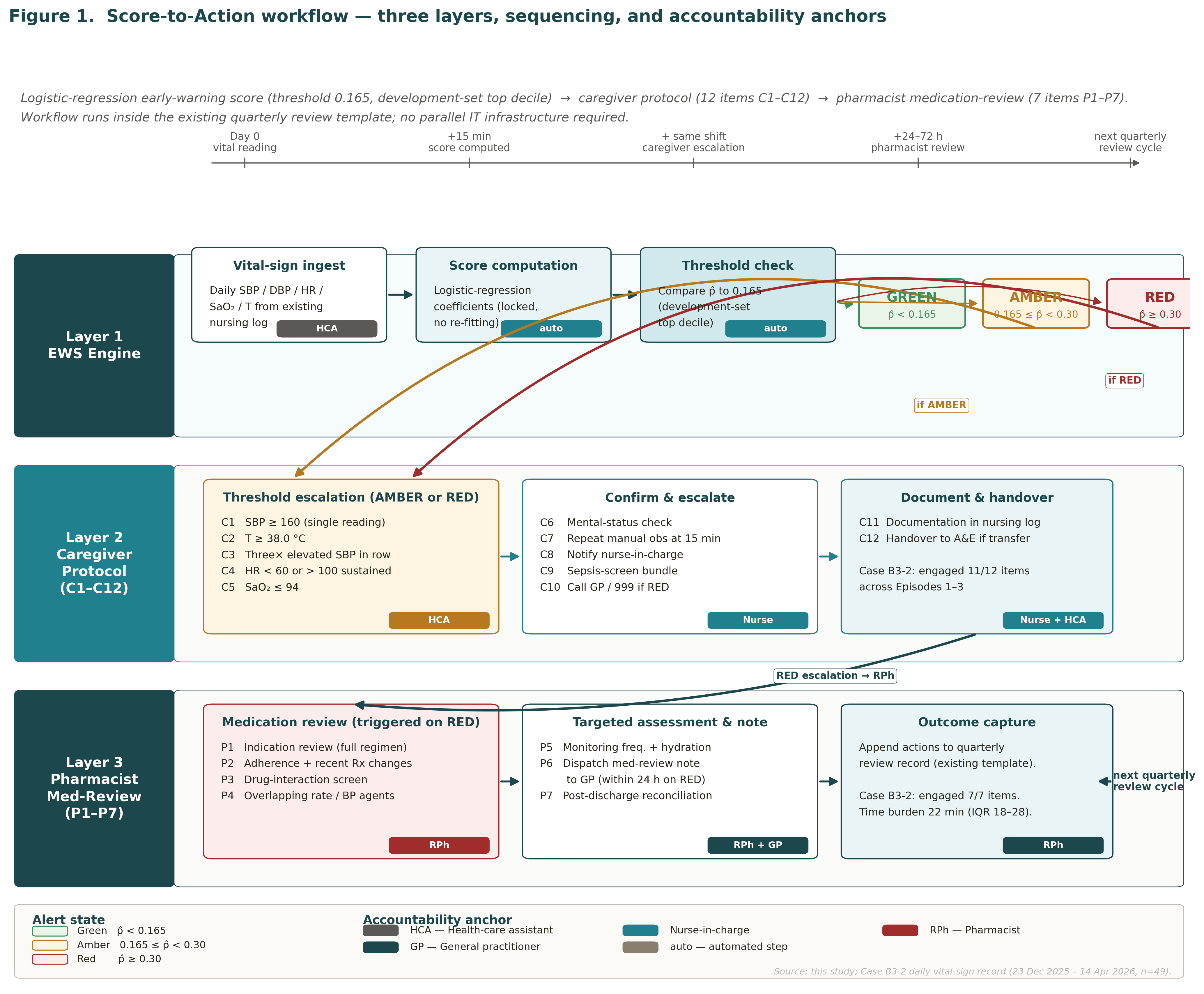
A logistic regression model converts the quarterly vital-sign record of each resident into a single probability of hospitalisation in the next 90 days.
The score routes attention to the right clinician at the right time. Green for routine care, Amber for pharmacist review, Red for physician escalation — within defined timeframes.

Figure 1: Logistic-regression EWS → caregiver protocol (C1–C12) → pharmacist medication review (P1–P7). Runs inside the existing quarterly review template.
Designed for the existing Hong Kong workforce. The model recommends a route; the pharmacist and physician make every clinical decision.
Designed within HK Personal Data (Privacy) Ordinance (Cap. 486) and Pharmacy & Poisons Ordinance (Cap. 138). Data stays on-premises.
Streamlined operations mean fewer errors, faster administration, and reduced hospital overload from better primary care.

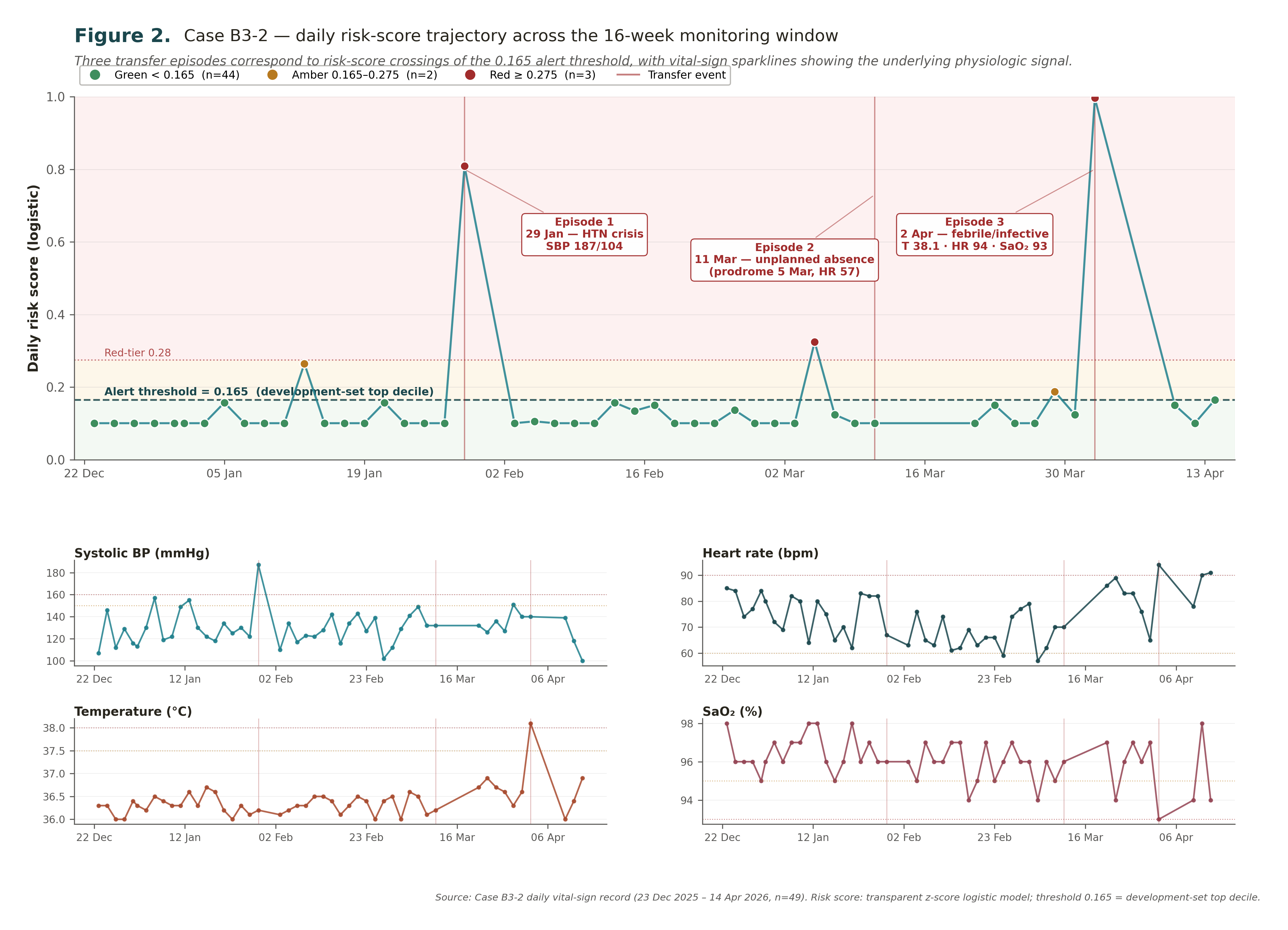
Figure 2: Daily risk-score trajectory across the 16-week monitoring window. Red dots mark hospital transfer episodes. Green/Amber zones show alert thresholds.
Whether you operate a single RCHE or a network of care homes, we would be glad to walk you through how our system fits your existing workflow — at no cost and no obligation.
1/F Room A, Honorfield Garden, 60 King's Road, North Point, Hong Kong
All data shared with us is handled in accordance with the Hong Kong Personal Data (Privacy) Ordinance (Cap. 486). We do not share your information with third parties.